.…Oyenusi smiles to his death
‘Doctor’ Ishola Oyenusi is a name etched in the history of
Nigeria as one of the most violent armed robbers, a criminal who unleashed
boundless terror on many Nigerians. But who was he and what did he do that his
name was associated with so much notoriety?
Nigeria as one of the most violent armed robbers, a criminal who unleashed
boundless terror on many Nigerians. But who was he and what did he do that his
name was associated with so much notoriety?
The Nigerian Civil War had just ended in 1970 but by the
early 1970s, a stone-hearted armed robber, Ishola Oyenusi (he called himself
Dr. Oyenusi even if he never finished the secondary school), was terrorising
all of Lagos, Nigeria’s largest commercial centre. Before one tale of his
daring exploits died down, another one had sprung up. Oyenusi was no ordinary
pilferer, this snitcher was downright wicked and had all the self-confidence in
the world to go with it. And you know something? He was quite romantic and
chivalrous. There was a story of how he snatched his first car on Herbert
Macaulay Road in Yaba, Lagos. Why? His girlfriend was broke. He eventually sold
the car for N400 but the sad part was that in the process of stealing the car,
the poor owner was shot dead. He actually snatched the first car he saw on the
road. Such was the ferocious nature of his audacity.
early 1970s, a stone-hearted armed robber, Ishola Oyenusi (he called himself
Dr. Oyenusi even if he never finished the secondary school), was terrorising
all of Lagos, Nigeria’s largest commercial centre. Before one tale of his
daring exploits died down, another one had sprung up. Oyenusi was no ordinary
pilferer, this snitcher was downright wicked and had all the self-confidence in
the world to go with it. And you know something? He was quite romantic and
chivalrous. There was a story of how he snatched his first car on Herbert
Macaulay Road in Yaba, Lagos. Why? His girlfriend was broke. He eventually sold
the car for N400 but the sad part was that in the process of stealing the car,
the poor owner was shot dead. He actually snatched the first car he saw on the
road. Such was the ferocious nature of his audacity.
Oyenusi’s arrogance was also legendary. In 1970, he was
arrested and handcuffed by a police officer. As the policeman was ordering him
around, Oyenusi blasted him and thundered:
arrested and handcuffed by a police officer. As the policeman was ordering him
around, Oyenusi blasted him and thundered:
‘People like you don’t talk to me like that when I am armed.
I gun them down.’
I gun them down.’
Hmmm, but that was not all. Oyenusi was so feared that when
the famed movie director, Chief Eddie Ugbomah made a film titled The Rise and
Fall of Dr. Oyenusi in 1977, there was no one bold enough to come forward to
act the role of the armed robber because they feared his members would show
them shege. Ugbomah had no other option but to act the role himself with the
feature film depicting the senseless violence of armed robberies and the
absolutely atrocious manner by which lives of innocent Nigerians were snuffed
out. But there was one interesting thing that happened: a medical doctor by the
name of Dr. Oyenusi was so mad at the film producer that he headed for the
court trying to stop the shooting of the movie.
the famed movie director, Chief Eddie Ugbomah made a film titled The Rise and
Fall of Dr. Oyenusi in 1977, there was no one bold enough to come forward to
act the role of the armed robber because they feared his members would show
them shege. Ugbomah had no other option but to act the role himself with the
feature film depicting the senseless violence of armed robberies and the
absolutely atrocious manner by which lives of innocent Nigerians were snuffed
out. But there was one interesting thing that happened: a medical doctor by the
name of Dr. Oyenusi was so mad at the film producer that he headed for the
court trying to stop the shooting of the movie.
Actually, Ugbomah was threatened. He received a letter from
thieves who invaded and looted his provision store, carting away all they
could. In the letter, they promised to return his goods if he would only stop
shooting the film in which he exposed the support received by the armed robbers
from their ‘godfathers’ and even high-ranking officers in the Nigerian Armed
Forces. The stubborn Ugbomah called their bluff and went ahead with the
16mm-flick (kindly send us a clip of this film if you have one). Ugbomah would
later produce many other films such as Death of a Black President (1983), Esan
(Nemesis), The Mask and Vengeance of the Cult in 1985. Death of a Black
President was about the assassination of General Murtala Muhammed (read all
about him
here>>>http://www.abiyamo.com/murtala-muhammed-nigerias-most-popular-leader/
thieves who invaded and looted his provision store, carting away all they
could. In the letter, they promised to return his goods if he would only stop
shooting the film in which he exposed the support received by the armed robbers
from their ‘godfathers’ and even high-ranking officers in the Nigerian Armed
Forces. The stubborn Ugbomah called their bluff and went ahead with the
16mm-flick (kindly send us a clip of this film if you have one). Ugbomah would
later produce many other films such as Death of a Black President (1983), Esan
(Nemesis), The Mask and Vengeance of the Cult in 1985. Death of a Black
President was about the assassination of General Murtala Muhammed (read all
about him
here>>>http://www.abiyamo.com/murtala-muhammed-nigerias-most-popular-leader/
In the 1970s, Oyenusi was no doubt the uncrowned emperor of
Nigerian robbers and he is described as the ‘first celebrated armed robber in
Nigeria’. He is regarded by some as the pioneer of conventional armed robbery
in Nigeria. When Oyenusi reigned at the height of his regal confidence, he
declared:
Nigerian robbers and he is described as the ‘first celebrated armed robber in
Nigeria’. He is regarded by some as the pioneer of conventional armed robbery
in Nigeria. When Oyenusi reigned at the height of his regal confidence, he
declared:
‘The bullet has no power.‘
As at that time, armed robbers were condemned to death and
thousands joyfully came out to ‘enjoy’ the grisly public executions before the
firing squad on the pristine beaches of Lagos. Although Nigeria no longer has
very ‘famous’ bandits and thieves like Anini (at the age of 26, Lawrence
Nomayagbon Anini was the most notorious robber in Nigeria), Babatunde
Folorunsho, Monday Osunbor, Shina Rambo, Buraimoh Jimoh, Oyenusi, ‘Mighty Joe’,
‘Captain Blood’ and George Iyamu (a former Deputy Superintendent of Police who
was Anini’s collaborator), armed robbery is nonetheless a major problem in the
nation.
thousands joyfully came out to ‘enjoy’ the grisly public executions before the
firing squad on the pristine beaches of Lagos. Although Nigeria no longer has
very ‘famous’ bandits and thieves like Anini (at the age of 26, Lawrence
Nomayagbon Anini was the most notorious robber in Nigeria), Babatunde
Folorunsho, Monday Osunbor, Shina Rambo, Buraimoh Jimoh, Oyenusi, ‘Mighty Joe’,
‘Captain Blood’ and George Iyamu (a former Deputy Superintendent of Police who
was Anini’s collaborator), armed robbery is nonetheless a major problem in the
nation.
THE END
In March 1971, Oyenusi was nabbed by the Nigerian Police
after he organized a robbery in which $28,000 (value as at that time) was
stolen. They killed a police constable in the process. Although the first
public execution of robbers had taken place in April 1971, that of Oyenusi and
his criminal allies was a special case and the Lagos government took time to
prepare the grounds at the Bar Beach.
after he organized a robbery in which $28,000 (value as at that time) was
stolen. They killed a police constable in the process. Although the first
public execution of robbers had taken place in April 1971, that of Oyenusi and
his criminal allies was a special case and the Lagos government took time to
prepare the grounds at the Bar Beach.
By 8.am, officials were already at the execution arena to
check the whole place just to ensure that everything went on ‘well’. A combined
team of police officers and soldiers struggled to contain the surging crowd of
thousands of excited spectators. At about 9.15 am, a team of Lagos City Council
workers came to the execution arena with empty mock coffins which they calmly
laid behind the execution stand. Obviously, they were there to make fun of a
man who had sent so much terror into their hearts. About half an hour later, eight robbers were
led to the execution stand…
check the whole place just to ensure that everything went on ‘well’. A combined
team of police officers and soldiers struggled to contain the surging crowd of
thousands of excited spectators. At about 9.15 am, a team of Lagos City Council
workers came to the execution arena with empty mock coffins which they calmly
laid behind the execution stand. Obviously, they were there to make fun of a
man who had sent so much terror into their hearts. About half an hour later, eight robbers were
led to the execution stand…
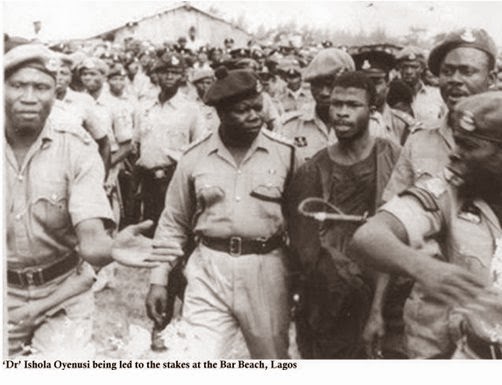
HIS EXECUTION DAY
On the day of Oyenusi’s execution, over 30,000 Nigerians
trooped to the famous Bar Beach (armed robberies were quite rare then and when
it happened, it was the gist of the town for months so the considerably high
level of the people’s curiosity can be appreciated). While some in the crowd
jeered and booed Oyenusi and his Gang of Seven, some of his friends and family
members present could not hold back their tears. But for most of the witnesses,
it was good riddance to bad nonsense. As
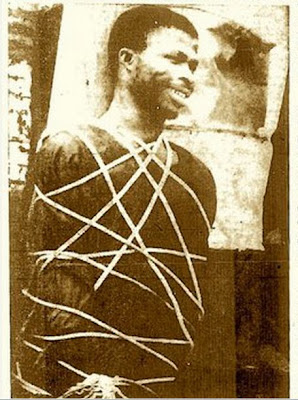
for Oyenusi, he was smiling, smiling to the last but the agony on his face too
was unmistakable. But just few minutes before his body was riddled with hot-leaded
bullets from stern-faced soldiers of the Nigerian Army, he finally confessed
saying:
trooped to the famous Bar Beach (armed robberies were quite rare then and when
it happened, it was the gist of the town for months so the considerably high
level of the people’s curiosity can be appreciated). While some in the crowd
jeered and booed Oyenusi and his Gang of Seven, some of his friends and family
members present could not hold back their tears. But for most of the witnesses,
it was good riddance to bad nonsense. As
for Oyenusi, he was smiling, smiling to the last but the agony on his face too
was unmistakable. But just few minutes before his body was riddled with hot-leaded
bullets from stern-faced soldiers of the Nigerian Army, he finally confessed
saying:
‘I am dying for the offence I have committed.‘
Two army trucks and a black van conveyed them to the firing
spot. Oyenusi was in the black van. In seconds, three soldiers flew out of the
army trucks and proceeded to the black van inside which was Nigeria’s most
dreaded armed robber. The soldiers came to a screeching halt and stood at
attention by the van. All of a sudden, one of them let out a shrill command! The
door was flung open and slowly, Oyenusi appeared from within the darkness of
the Black Maria. As if the heavens were in concert, dark clouds had formed over
the Bar Beach. He was cloaked in a dark long-sleeved shirt and his hands were
tied behind his back. He spotted a pair of dark loafers and his trousers were
wrinkled. Sweating profusely, he kept throwing fast glances around as if he was
looking for someone as he surveyed the crowd who had thronged the beach to
simply see him die.
spot. Oyenusi was in the black van. In seconds, three soldiers flew out of the
army trucks and proceeded to the black van inside which was Nigeria’s most
dreaded armed robber. The soldiers came to a screeching halt and stood at
attention by the van. All of a sudden, one of them let out a shrill command! The
door was flung open and slowly, Oyenusi appeared from within the darkness of
the Black Maria. As if the heavens were in concert, dark clouds had formed over
the Bar Beach. He was cloaked in a dark long-sleeved shirt and his hands were
tied behind his back. He spotted a pair of dark loafers and his trousers were
wrinkled. Sweating profusely, he kept throwing fast glances around as if he was
looking for someone as he surveyed the crowd who had thronged the beach to
simply see him die.

As the soldiers grabbed and tied him to the pole, he was
still scanning through the crowd. One of the giggling spectators in the crowd
whispered to the next ‘Who is he looking for?‘. Smartly, seven soldiers formed
a lethal line in front of Oyenusi. A soldier let out a fierce command to the
sharpshooters. All of them took aim at Oyenusi. The next voice reverberated all
over Nigeria:
still scanning through the crowd. One of the giggling spectators in the crowd
whispered to the next ‘Who is he looking for?‘. Smartly, seven soldiers formed
a lethal line in front of Oyenusi. A soldier let out a fierce command to the
sharpshooters. All of them took aim at Oyenusi. The next voice reverberated all
over Nigeria:
‘Fire!’
Like an electrocuted being, his body shook vigorously as he
slumped and went limp around the pole that held his remains.
slumped and went limp around the pole that held his remains.
For a man who said bullets had no power to penetrate his
skin, he slumped in seconds, surrendering to the high-velocity missiles
directed at his mortal vessel. His fragile human body could not withstand the
pitiless hail of gunfire, amplified by the metallic drums behind them. Some of
the robbers refused the final blessings from the priest while some of them look
clearly frightened as the soldiers aimed at them. The basic human instinct of
survival betrayed their emotions. Some others shouted their protests and
defiance to the last as live cameras of the journalists sent the gory details
to those at home watching the spectacle on their black-white television sets.
skin, he slumped in seconds, surrendering to the high-velocity missiles
directed at his mortal vessel. His fragile human body could not withstand the
pitiless hail of gunfire, amplified by the metallic drums behind them. Some of
the robbers refused the final blessings from the priest while some of them look
clearly frightened as the soldiers aimed at them. The basic human instinct of
survival betrayed their emotions. Some others shouted their protests and
defiance to the last as live cameras of the journalists sent the gory details
to those at home watching the spectacle on their black-white television sets.
However, Oyenusi, who confessed that he joined the armed
robbery business in 1959, was not to die alone. He was to end his journey on
earth with six of his other gang members whom he had led to their last robbery
at the WAHUM factory at Ikeja, Lagos on the 27th March, 1971. These included:
robbery business in 1959, was not to die alone. He was to end his journey on
earth with six of his other gang members whom he had led to their last robbery
at the WAHUM factory at Ikeja, Lagos on the 27th March, 1971. These included:

-Joel Amamieye
-Ambrose Nwokobia
-Stephen Ndubuokwu
-Philip Ogbolumain
-Joseph Osamedike
-Ademola Adegbitan
Amamlaye was a former Personnel Manager at WAHUM where they
robbed while Nwokobia was the gateman at the same place. During the robbery,
they killed a police constable named Mr. Nwi. An eighth man, Isaac Ekwunife was
also executed for robbing a man of a car in Surulere, Lagos in early 1971.
robbed while Nwokobia was the gateman at the same place. During the robbery,
they killed a police constable named Mr. Nwi. An eighth man, Isaac Ekwunife was
also executed for robbing a man of a car in Surulere, Lagos in early 1971.

By the time the guns stopped vomitting the bullets, Oyenusi
and his cohorts were dead bringing to a total of 70 armed robbers executed
after the Nigerian Civil War ended in 1970. As hinted earlier, death by firing
squad was the order of the day as at that time. Following Oyenusi’s execution,
the Information Officer stationed at the
Nigerian Embassy in Washington DC, Femi Davis was interviewed on the matter. He
said:
and his cohorts were dead bringing to a total of 70 armed robbers executed
after the Nigerian Civil War ended in 1970. As hinted earlier, death by firing
squad was the order of the day as at that time. Following Oyenusi’s execution,
the Information Officer stationed at the
Nigerian Embassy in Washington DC, Femi Davis was interviewed on the matter. He
said:
It is the law to shoot persons convicted of armed robbery,
that is the robbery with armed violence. The law was passed last year by the
Federal Government because we wanted to make it tough for criminals who began
preying upon villages and people on the highway looking for easy money.
that is the robbery with armed violence. The law was passed last year by the
Federal Government because we wanted to make it tough for criminals who began
preying upon villages and people on the highway looking for easy money.
Oyenusi, the man also known as ‘Dr. Rob-and-Kill’ and his
gang met their brutal end at the hands of a 14-man firing squad on the serene
Victoria Island of Lagos. According to one of his defence lawyers who visited
him while in jail, Oyenusi was imprisoned for the first time when he was 21. He
then escaped and was imprisoned again. He escaped AGAIN and was imprisoned
AGAIN. He escaped about eight times and then he decided to become an armed
robber and that gave him the cloak of invincibility for some time. According to
Ebenezer Babatope, former Minister of Transport in his book, The Struggle for
Power in Nigeria, Oyenusi told journalists minutes before his death that he
would never have become an armed robber if his parents were rich enough to
sustain him in the secondary school. He also confessed to taking part in ten
major robberies and murders over a period of six years (Africa Research
Bulletin, Blackwell, 1971).
gang met their brutal end at the hands of a 14-man firing squad on the serene
Victoria Island of Lagos. According to one of his defence lawyers who visited
him while in jail, Oyenusi was imprisoned for the first time when he was 21. He
then escaped and was imprisoned again. He escaped AGAIN and was imprisoned
AGAIN. He escaped about eight times and then he decided to become an armed
robber and that gave him the cloak of invincibility for some time. According to
Ebenezer Babatope, former Minister of Transport in his book, The Struggle for
Power in Nigeria, Oyenusi told journalists minutes before his death that he
would never have become an armed robber if his parents were rich enough to
sustain him in the secondary school. He also confessed to taking part in ten
major robberies and murders over a period of six years (Africa Research
Bulletin, Blackwell, 1971).
Nigerians now travel with fear (some families have even
banned night travels) and move with trepidation while the security forces are
either too demoralized, outnumbered (which serious nation of 170 million on
earth will be policed by 370,000 police officers, does that make any ‘zenze’?
Russia with about 143 million people has almost one million police officers
equipped with armed helicopters, A-91 rifles, Makarov and Grach pistols,
armoured vehicles, police buses, carbines, vans, all-terrain vehicles (where
are those ALGON police jeeps Obasanjo bought?)) or under-armed to launch any
reasonable counterattack or simply join ranks with the lawbreakers. Hopefully,
a time will come when Nigeria will be rid of this vermin called armed robbery
(and yeah, pen robbery too).
banned night travels) and move with trepidation while the security forces are
either too demoralized, outnumbered (which serious nation of 170 million on
earth will be policed by 370,000 police officers, does that make any ‘zenze’?
Russia with about 143 million people has almost one million police officers
equipped with armed helicopters, A-91 rifles, Makarov and Grach pistols,
armoured vehicles, police buses, carbines, vans, all-terrain vehicles (where
are those ALGON police jeeps Obasanjo bought?)) or under-armed to launch any
reasonable counterattack or simply join ranks with the lawbreakers. Hopefully,
a time will come when Nigeria will be rid of this vermin called armed robbery
(and yeah, pen robbery too).
Trivia: The military government of General Yakubu Gowon
approved the public executions of armed robbers. During his regime, the trend
of armed robbery was becoming disturbing, a decree was passed, robbers faced
the Armed Robbery Tribunal and were promptly shot. You can read all about
General Yakubu Gowon
here>>>http://www.abiyamo.com/yakubu-gowon-nigerias-wartime-leader/
approved the public executions of armed robbers. During his regime, the trend
of armed robbery was becoming disturbing, a decree was passed, robbers faced
the Armed Robbery Tribunal and were promptly shot. You can read all about
General Yakubu Gowon
here>>>http://www.abiyamo.com/yakubu-gowon-nigerias-wartime-leader/
Thanks for your time.
-ABIYAMO
Follow Us on Facebook – @LadunLiadi; Instagram – @LadunLiadi; Twitter – @LadunLiadi; Youtube – @LadunLiadiTV for updates