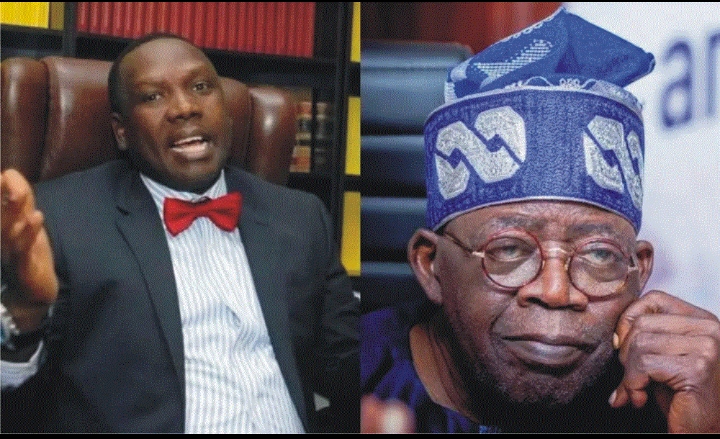
Special Adviser to the President on Policy Communication and Media, Daniel Bwala, has dismissed claims that he once described President Bola Ahmed Tinubu as a drug lord, insisting the allegation is false and rooted in social media misinformation
Speaking during an interview on News Central, Bwala challenged anyone with evidence to present it immediately, maintaining that he has never made such a statement.
“I have never in my life addressed Bola Tinubu as a drug lord. In fact, I have never believed in it,” he said.

“If you have it here, we can shut the interview and you produce it.”
He also addressed another viral claim suggesting he once said giving Tinubu 30 years in office would not change anything. Bwala clarified that the statement was taken out of context from an interview he granted Channels Television on December 25, 2023.
According to him, his actual remark was directed at government policies, not the president’s tenure.
“I said, where a policy is fundamentally flawed, that 30 years will not correct it,” he explained, noting that the comment was twisted after circulating online.
Bwala said he still has the original video and even offered to play it during the interview to clear any doubt.
Using the incident as a broader example, he criticised sections of the Nigerian media for relying on unverified social media reports, warning that such practices are damaging public trust.
“Now, when you mentioned it was reported in the paper, that is the second question that the Nigerian media should begin to look at, how social media now set the tone and agenda for mainstream media. And this is where we have the problem in Nigeria today.
“Believe me, I’m telling you, I see some television houses, not all of them, where they report stories on social media that were unverified, as though it is a verified information and people run to town with it.”
He stressed that journalism, like academic research, requires going back to original sources before publishing any claim.
“If, for example, assuming you’re running a newspaper, and you see a social media that says something like that, for the purposes of verifying your information, which is part of the ethics, we need to say, let me go to the source.
“Now, as a researcher, I will tell you the discipline in research. It is not enough that you are citing a reference, or that you come across a reference. It’s important you go to the source of the book that was referenced… so that when you say something, it will be cast in stone.”
Bwala, however, acknowledged that while many journalists remain professional, a few have embraced sensational social media trends driven by outrage and monetisation.
“But I can understand that journalism now has taken a different dimension, that very good journalists, their good work is being overshadowed by the conduct of very few minority who have mastered the nuances of social media that feeds off of vitriol and hate for the monetisation of revenue,” he said.
Follow Us on Facebook – @LadunLiadi; Instagram – @LadunLiadi; Twitter – @LadunLiadi; Youtube – @LadunLiadiTV for updates