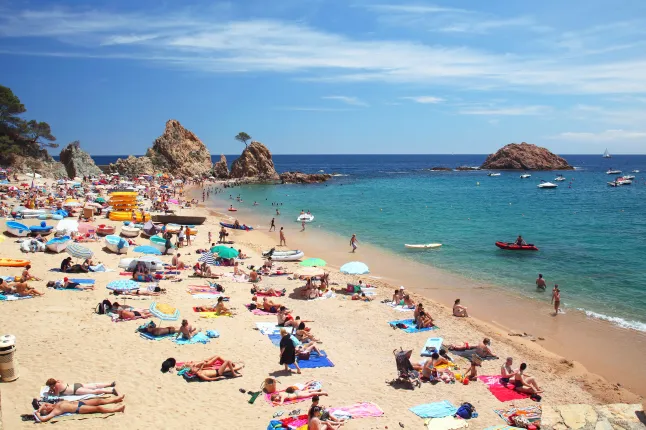
Warmer seas are bringing a little-known and potentially dangerous visitor closer to European beaches
In recent years, parts of Europe have experienced episodes of pollution and health alerts that have led to restrictions on access to the sea.
Now, as the water gets ever warmer and tourism pressure mounts, concerns are growing over a specific strain of bacteria that is often described as ‘flesh-eating’.
‘[This bacteria] has always been present in coastal waters, it’s not a new or exotic threat,’ Arif Gasilov, partner at environmental consultancy Gasilov Group, tells Metro.
‘However, as warmer seas expand their range due to global warming, this also extends the season in which concentrations reach dangerous levels.
‘This risk concentrates at river mouths, lagoons, places like that with warm water plus reduced salinity. These are also where people tend to swim.’
The threat
Experts are particularly concerned about the Vibrio bacterium, a family of naturally occurring microorganisms found in warm, brackish coastal waters.
Most strains are harmless. But some – such as Vibrio vulnificus, the one described as ‘flesh-eating’ – can cause severe and, in rare cases, even fatal infections.
The risk is heightened in people with open wounds or weakened immune systems.
In the worst scenarios, infection can trigger necrotising fasciitis, a condition where the tissue around a wound rapidly breaks down.
Bacteria can then enter the bloodstream, causing sepsis. In rare cases, some patients require amputation.
Follow Us on Facebook – @LadunLiadi; Instagram – @LadunLiadi; Twitter – @LadunLiadi; Youtube – @LadunLiadiTV for updates




SMH