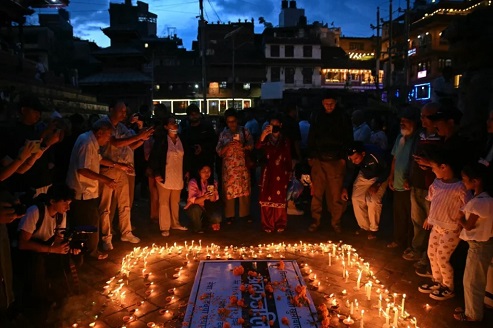
Nepal today held a national day of mourning for victims of the devastating glacial floods, as families of missing hydropower workers feared trapped in tunnels prayed rescuers might yet find them alive
The August 26 glacial and mountain collapse on the China-Nepal border k!lled at least 1,398 people, with more than 5,500 missing, including around 800 foreigners.

Flags flew at half-mast, with candlelight vigils planned later in the day, as the nation marked the 13th day after the d8aths, following Hindu mourning rituals.
Hundreds of hydropower workers are among the missing, but the rescue of three of them from deep inside tunnels — two Nepalis on Friday and a Chinese man on Saturday — have buoyed hopes that more could still be alive.

Nepal Army spokesman Raja Ram Basnet said rescue efforts were continuing at “the same tempo” to make sure “that no one is still stranded”.
Entire communities have been swept away, with roads destroyed and homes demolished.
But families of some of the missing workers who gathered in the capital Kathmandu said the government must move faster.
“We have a lot of hope,” said Reena Amatya Shrestha, whose brother is among the missing.
“They say they are doing rescue. If the rescue is there, where’s the result? We need the result.”
Australian tunnel rescue expert Arnold Dix, who is advising Nepali teams, said the operation presented an unprecedented challenge.
“We are facing something I have never faced before,” said Dix, president of the International Tunnelling and Underground Space Association, in a post on social media.

“Not one rescue, but multiple potential rescues, unfolding at the same time, in different places, each with its own dangers, uncertainties, and lives that may still be saved.”
Foreign experts, including from China, India and South Korea, are aiding Nepali teams in rescue efforts.
“We are measured not only by the lives we save, but by the lives we refuse to abandon,” said Dix.
Drone pilot Adarsha Raj Bhusal recalled sinking into mud after leaping from a helicopter into the flood-ravaged Upper Trishuli-1 hydropower tunnel in Rasuwa district days after the disaster.
“The moment I landed I sank into the mud up to my waist,” the 24-year-old told AFP on Monday in Nuwakot district.
“Other soldiers were there to help, but they were struggling just as much as I was. That’s how bad the conditions were… It was intense the entire way in.”
With mortuaries overflowing, Nepal has buried hundreds of bodies in mass graves after taking DNA samples for future identification, according to police.
Follow Us on Facebook – @LadunLiadi; Instagram – @LadunLiadi; Twitter – @LadunLiadi; Youtube – @LadunLiadiTV for updates