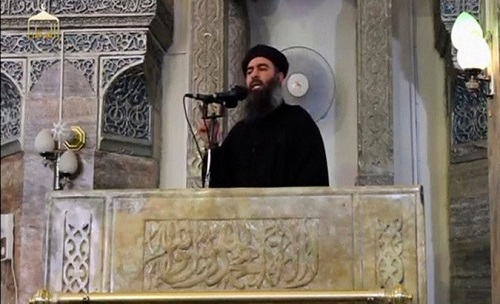
Abu Bakr al-Baghdadi, said to be the Islamic State’s leader,
in an image taken from the website of a militant group last July
in an image taken from the website of a militant group last July
The Islamic State’s reclusive leader has empowered his inner
circle of deputies as well as regional commanders in Syria and Iraq with
wide-ranging authority, a plan to ensure that if he or other top figures are
killed, the organization will quickly adapt and continue fighting, American and
Iraqi intelligence officials say.
circle of deputies as well as regional commanders in Syria and Iraq with
wide-ranging authority, a plan to ensure that if he or other top figures are
killed, the organization will quickly adapt and continue fighting, American and
Iraqi intelligence officials say.
The officials say the leader, Abu Bakr al-Baghdadi,
delegates authority to his cabinet, or shura council, which includes ministers
of war, finance, religious affairs and others.
delegates authority to his cabinet, or shura council, which includes ministers
of war, finance, religious affairs and others.
The Islamic State’s leadership under Mr. Baghdadi has drawn
mainly from two pools: veterans of Al Qaeda in Iraq who survived the insurgency
against American forces with battle-tested militant skills, and former Baathist
officers under Saddam Hussein with expertise in organization, intelligence and
internal security. It is the merger of these two skill sets that has made the
organization such a potent force, the officials say.
mainly from two pools: veterans of Al Qaeda in Iraq who survived the insurgency
against American forces with battle-tested militant skills, and former Baathist
officers under Saddam Hussein with expertise in organization, intelligence and
internal security. It is the merger of these two skill sets that has made the
organization such a potent force, the officials say.
In delegating authority, Mr. Baghdadi has drawn lessons from
the fates of other militant groups, including that of a branch in Yemen called
Al Qaeda in the Arabian Peninsula, whose leaders have been whittled away by
repeated American drone strikes over the years, said a Western diplomat who
monitors the group.
the fates of other militant groups, including that of a branch in Yemen called
Al Qaeda in the Arabian Peninsula, whose leaders have been whittled away by
repeated American drone strikes over the years, said a Western diplomat who
monitors the group.
“ISIS has learned from that and has formed a structure that
can survive the losses of leaders by giving midlevel commanders a degree of
autonomy,” the diplomat said. In that structure, the overall operation would
not be immediately affected if Mr. Baghdadi were wounded or killed, he said.
can survive the losses of leaders by giving midlevel commanders a degree of
autonomy,” the diplomat said. In that structure, the overall operation would
not be immediately affected if Mr. Baghdadi were wounded or killed, he said.
Source: NYTimes
Follow Us on Facebook – @LadunLiadi; Instagram – @LadunLiadi; Twitter – @LadunLiadi; Youtube – @LadunLiadiTV for updates